Showing posts with label vegan. Show all posts

Tuesday, July 30, 2013

Cover those veggies: peanut sauce

What a plateful of naked vegetables and rice needs is a thick, sweet sauce to pull them all together.

Welcome this African inspired peanut sauce, based on a recipe from the Moosewood classic, "Sundays at Moosewood Restaurant." The Moosewood Restaurant in Ithaca, NY was part of a movement that tutored a generation of hippies and vegetarians in a new American cuisine, in which we seek out inspiration from everywhere in the world for methods and spices, while still eating what grows locally.


This peanut sauce is not made from such local stuff. But I start with local onions, and substitute local tomatoes (put up last year) for the juice in the original recipe. Plus, it's a delicious way to eat local vegetables.

Another kitchen tip: Buy bananas ahead, ripen in a bag, then freeze them in Ziplocs for smoothies, or to add to this dish.


Peanut Sauce

4 cups chopped onion
1/8 cup peanut oil
1/2 tsp cayenne
1 T freshly ground ginger root
2 mashed, ripe bananas
2 cups chopped tomatoes
1 cup apricot juice
1 cup peanut butter
1/4 tsp sea salt, or to taste

Saute chopped onions until clear, then add cayenne, ginger, and banana. Stir for 5 more minutes, then add juices and stir in. Simmer ten minutes, then add peanut butter and salt.

Serve over rice and steamed vegetables. Also excellent with chicken.


Friday, May 25, 2012

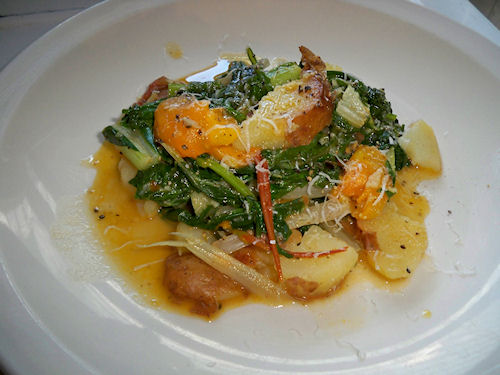
Recipe: Roman hash


The types of greens or potatoes you use in Roman Hash are up to you; you can even choose to fry the potatoes in bacon fat, or skip the cheese at the end. If you use both very hearty greens (such as collards) and very delicate greens (such as arugula), chop them into separate bowls, and add the heartier greens to the pan first.


Serves 4 as a light meal or a substantial side dish.

Ingredients
⅓ cup olive oil
4 medium potatoes, boiled
3 medium tomatoes, or comparable quantity of canned whole tomatoes, diced (not canned diced tomatoes): about a pound
6+ cloves of garlic, pressed or finely minced
7+ cups of washed, loosely packed, chopped cooking greens (e.g. collards, kale, mustard greens, dandelion greens, arugula, chard)
½ tsp salt, or to taste
¼ tsp freshly ground pepper, to taste
Pecorino Romano or your favorite hard grating cheese, to taste (optional)

Equipment Needed
Large (14-inch or larger) nonstick skillet (an iron skillet is preferable)
Large pot with a lid
Colander
Cutting board and knife
Garlic press (preferable but not required)
Fine grater for cheese (if using)

Slice the boiled potatoes into half-inch thick rounds. Put the skillet on a medium-high flame and add the olive oil. When the oil is hot, add the potato slices in a single layer. Allow the potatoes to cook, undisturbed, for several minutes until they are lightly browned. Salt and pepper, and turn and redistribute the potatoes as needed to brown and heat the slices.

Add the tomatoes and garlic and stir, allowing the potato slices to break up. Cook for a few minutes, salt and pepper some more, then add the greens, stirring in a large handful at a time and allowing them to wilt slightly to make room for more. Continue to cook and stir until the greens are completely wilted and the dish is not too soupy. Taste for salt and pepper. Serve with a grating of hard cheese, if desired.

Monday, January 2, 2012

Three quick breads


Quick breads are an easy way to make dinner special. If you’re new to cooking at home, learning one of these dishes will give you a flexible staple you can make your own: add chocolate chips or bacon grease to brownies, your favorite herbs or cheese to farinata, corn or bacon to plain cornbread, and it’s a whole new dish. Since each of the these three quick breads can be made without wheat flour, they’re especially welcome treats for people on gluten-free diets.

What’s a quick bread? Generally speaking, a quick bread is an American term for baked goods made with chemical leaveners instead of yeast. These are breads that are best served hot and fresh, and can be part of any meal, snack, or dessert. Common quick breads include buttermilk biscuits, scones, and cornbread. In addition to savory items, quick breads include sweet cakes, soda bread, banana bread, and the like, as well as brownies.

For this post, I’m using the term more broadly to include any baked goods that don’t use yeast or fermentation, and so can be turned out quickly.

Pro-tip: If you new to quick breads and working with wheat flour, don’t over beat your batter. This causes the gluten to develop, and will make your bread tough.

Quick breads are newbie-friendly. None of these breads require the binding action of gluten. This makes quick bread an ideal category to start with, if you’re learning to bake gluten-free.  

Brownies are a sweet quick bread.
Brownies. Usually made with eggs to leaven, especially the chewier varieties. My go-to gluten free brownie recipe uses coconut flour and a little rice flour. “Let’s Do... Organic” brand coconut flour features a recipe for “Alison’s Wheat Free Brownies” on the back, which I found here online. This post from the “Nourished Kitchen” blog is a general primer on subbing coconut flour in baking.

Cornbread. Although most gluten-free baking primers will suggest something other than a 1:1 ratio, substituting rice flour for the wheat flour in my regular recipe for cornbread, out of Mark Bittman’s How To Cook Everything, turns out a good result. It’s a little paler in color, but has great flavor and texture, and only slightly more crumbly than regular cornbread made with wheat flour. I made it with blue cornmeal once and the resulting bread was sort of pink. A little weird-looking, but it tasted good.


Farinata. While not technically a quick bread, farinata’s texture and utility make this more like cornbread or polenta than the pancakes and crêpes it is compared with. Made with chickpea flour, this traditional Italian dish is a versatile starting point for a whole meal. You can make a thin, herbed farinata to accompany soup or stew, or you can make a thicker one and add vegetables and cheese. This could be a great vegan breakfast: chickpea flour, olive oil, garlic, fresh oregano, and some cooked vegetables, all cooked together in a skillet. Cold farinata is good, and can be creatively topped and broiled. Farinata topped with pepperoni slices and cheese and broiled until the cheese melts is a tasty grain-free pizza.

Tuesday, October 11, 2011

Vegetables for breakfast

A fresh tomato and herb frittata with cheese


Most people eating Western diets could use some more vegetables in their day. One meal that is often overlooked as an opportunity for adding a healthy serving of veggies is breakfast. The most important meal of the day can also be the cheapest, healthiest meal, and one that satisfies you easily until lunchtime.


A hearty breakfast will provide you with roughly a third of the food you plan to eat all day. Common breakfast foods like bagels, breakfast cereals and bars, and other pastries pack a lot of carbohydrate, and while some are fortified with vitamins and minerals, they're usually still weak on the other macronutrients. A balanced breakfast has protein, fat, and fiber as well as carbs, and about a third of your caloric needs. Eating enough at breakfast, and particularly foods that keep you feeling full—fat, protein, and fiber are especially satiating for their caloric density—will give you energy and focus to get through the morning.


You can make something ahead, like a frittata that tastes just as good cold as it does hot. You can whip something up from last night's leftovers, or make something fast and fresh. Here are a few ideas.

Beef soup for breakfast
In many parts of the world, it’s common to start the day with a hot bowl of soup. My husband likes to make his own. He warms a cup of beef or chicken stock in a pan on the stove while he juliennes or shreds a little bit of vegetable: some cabbage or another leafy green vegetable, plus a bit of sweet bell pepper or root vegetable. He cooks these in the warm stock while thinly slicing some beef chuck steak. Chuck is his favorite and is one of the cheapest cuts, though if you prefer leaner or higher quality meat, try top round or sirloin. For beef soup he prefers beef stock, but sometimes he gets pork for breakfast, and says that it tastes best with chicken stock. Whichever kind of meat he uses, he slices it thinly and adds the meat to the soup last: it cooks in less than a minute. He eats it with a squeeze of sriracha hot sauce. The amounts of meat and vegetable he uses are not very large, about half of a typical serving. Later in the day he has a smoothie with milk, yogurt, and fruit, complementing the soup by adding fat and carbohydrate to his protein-rich breakfast. Both are full of vitamins and enough fat for their absorption.


Eggs with greens. I haven't gotten into Kevin's soup routine, preferring the comforting familiarity of eggs for breakfast. I share coffee and a smoothie, then take a walk with our dog. After I come home and shower, I’m ready to eat something more substantial. For most of the summer I ate grilled egg and cheese sandwiches. Other times, I make a more composed plate, and then I like to add some greens to my dish. A typical breakfast of eggs and greens starts with a handful of fresh, chopped collards or kale sauteed in butter or bacon fat, though other kinds of greens are also good (I love callaloo), and if I have leftover, cooked greens from the night before, I'll just warm a serving of those in a skillet. Then I move the greens to the side, and fry a couple eggs in the same pan.  When I fix my plate, I put the greens on the bottom, and top them with the eggs. Sometimes, after cooking the greens, I will just make a little hole in the middle, and fry the eggs in the hole. Then I can warm a split sausage in the same pan, and it won’t get coated in egg. A lazy method, yet still makes an appealing breakfast.

Fried eggs over sauteed collards, a split half-link of curry sausage, and a wedge of cantaloupe

Another way I like to eat vegetables with eggs is as huevos rancheros. When I have leftover cornbread and/or chili, I incorporate them into my breakfast. I split a wedge of cornbread, butter and toast it in a toaster oven. You can also fry your cornbread in a skillet. Warm the chili in a small, covered saucepan and when it’s hot, crack the eggs into the chili and poach them, covered, until they’re opaque. Part of the thrill of eggs in chili is cutting through the molten yolks and having them run through the chili, making everything taste very rich. Consider that many French sauces are little more than egg yolk, and this seems less strange.


If I don’t have cornbread, I just eat the chili and eggs: maybe with some grated cheese, chopped avocado, pico de gallo or salsa, or some sriracha. My chili is full of vegetables, including kale, usually, and tomatoes, as well as peppers and sometimes squash or sweet potatoes. If I have cornbread, I serve the eggs over them, either with the chili or fried in a skillet with greens. For a rich meal like this, I like something to cut it: salsa, or a piece of fresh fruit to eat alongside.


Potatoes count as a vegetable, too. Hashed potatoes are tasty, cheap, and filling, and there are other ways to use potatoes in breakfast dishes, like these two recipes for spicy breakfast foods. Sweet potatoes baked or steamed from the night before are also good for breakfast, refried in butter. I like a little pinch of chili powder on them when I eat them this way with eggs. You could make a hearty vegan breakfast of white or sweet potatoes, cooked or refried beans, and sauteed greens.


Practically any prepared vegetable leftovers from last night’s dinner, from steamed kale to roasted eggplant, can be thrown into an omelet or scrambled eggs. Warm the fillings in a small saucepan before adding them to a cooked omelet. Fresh chopped tomatoes, avocados, green onions, and fresh herbs, with or without a grating of cheese, make an elegant filling for a breakfast omelet. Have your omelet alone or with fruit or toast, over polenta, or wrapped in a tortilla.


A portable and versatile breakfast dish is the burrito. Stuff it with leftover vegetables, cooked beans, eggs cooked any way, chopped up cooked leftover meat, cooked plain or seasoned rice, and anything else that appeals first thing in the morning.

Monday, July 25, 2011

Cool salads

This past January, I resolved to eat more raw foods. Near the end of winter—in the spring, really, but before any hint of spring produce in the markets—a co-worker turned me on to a food blog with an amazing celeriac salad. Authentically French, with an uncommon flavor and a refreshing, crisp texture, it put me on the hunt for composed side salads: the kind of dish that has a strong flavor and crunch, and which sets the stage for other flavors, whether as a complement to a rich, meaty entree or as a kind of amuse bouche. After celeriac season was over, I continued making the cabbage slaw I posted about at the same time: another good side salad, but we ate it all spring and I wore it out; and so this summer, I’ve been trying new ways to eat raw vegetables.

Through our long summer farm share season, we have lots of salad greens. I’ve whipped up a couple of vinaigrettes, adding a little dry mustard and ground cumin, fresh herbs, and green onions or garlic scapes if I had them, to pour over my usual salad of washed greens and lentil sprouts. I’ve also eaten some little salads of chopped summer squash and zucchini, with some sliced tomato and sprouts, with this dressing. This is a basic version:

Summer vinaigrette
Makes enough to dress 4 dinner salads

Ingredients
½ cup balsamic vinegar
½ cup olive oil
1T chopped fresh herbs: any one or combination of parsley, thyme, rosemary, marjoram or oregano, mint, basil, and cilantro
2-3 green onions, chopped
½ tsp ground dry mustard
½ tsp ground cumin
½ tsp salt
¼ tsp freshly ground pepper

Put all of the ingredients into a cruet and shake well. Serve at room temperature. Store extra dressing in the refrigerator for up to two weeks.

-

Last night I had company over for dinner, and whipped up a little cucumber salad dressed with fresh lemon juice, olive oil, and mint. This may become my chic little side salad this summer.

Cool cucumber salad
Serves 4 as a side salad

Ingredients
2 medium cucumbers
Juice of one lemon
2T olive oil
1T fresh spearmint, minced
Salt and pepper to taste

Peel the cucumber and slice it lengthwise. Use a melon baller to remove the seeds. Slice the cucumber into thin half-rounds. Dress with freshly squeezed lemon juice, olive oil, mint, salt, and pepper. Serve immediately; it will be okay the next day, but watery.

Friday, March 4, 2011

Spicy Breakfast Food

Need a hot breakfast? Here are two ideas. Both are spicy, and delicious any time, but especially well-suited to breakfast or brunch.

For this frittata, I used a large iron skillet. If you do not have an oven-safe skillet, after browning the sausage in a skillet on the stovetop, then pour the drippings into a pie plate, and layer it with the potato slices.


Pork chorizo and roasted cabbage frittata

1-1.5 lbs fresh pork chorizo sausage
5 medium potatoes, scrubbed
Half a head of cabbage
A dozen eggs
Salt and pepper to taste

Thinly slice the potatoes into 1/16" rounds. Slice the cabbage into small pieces, either by shredding or chopping.

Slice open the sausages to remove the meat; discard the casings. Brown the chorizo in a large skillet for a few minutes. Add the cabbage to the skillet and turn the heat down to medium. Simmer the cabbage, stirring occasionally, until it is tender: about ten minutes. Remove the cabbage and sausage mixture from the skillet and set aside.

Line the skillet with overlapping slices of potato, to completely cover the bottom and sides. Add the sausage and cabbage in an even layer.

Beat the eggs with salt and pepper, and pour them over the top of the sausage and cabbage to fill the skillet to within 1/2" of the top.

Bake at 350 degrees until the egg on top of the frittata is set and the visible edges of potato are very well browned: about 30 minutes. Allow to set for 5-10 minutes.

Slice and serve warm or cold.

--

This next dish is an aloo gobi recipe. In the original, Jaffrey has you soak the sliced vegetables in water before cooking with them, but I don't think it's a worthwhile step and always skip it.


Cauliflower and Potatoes with Fenugreek and Fennel Seeds


Adapted from Madhur Jaffrey's World of the East Vegetarian Cooking

A head of cauliflower
4 medium potatoes, scrubbed
1/4 cup olive oil
1/4 tsp fenugreek seeds
1 tsp fennel seeds
1 tsp cumin seeds
1/4 tsp red pepper flakes
3/4 tsp ground turmeric
1 tsp ground coriander
1 tsp salt
black pepper
1 tsp garam masala

Break up the cauliflower into florets and slice them into thin wedges, about 1/2" thick at the widest. Slice the potatoes thinly, about 1/4-1/8" thick.

Heat the oil in a large skillet that has a lid. Add the fenugreek, fennel, cumin, and red pepper. Stir for a minute, then add the sliced potatoes and cauliflower. Stir to completely coat in oil and spices. Sprinkle with the turmeric, coriander, salt, and pepper. Sauté for several minutes until vegetables begin to brown.

Add 1/4 cup of water to the skillet and cover, turning the heat to low. Steam the vegetables, stirring occasionally, until they are completely tender, about 15 minutes. Sprinkle with the garam masala, stir, and serve.

Thursday, February 24, 2011

Vegetarian comfort food: dal and mash with mustard cabbage

I recently transferred this Blogger account to the one associated with my more frequently used Gmail account. Having removed that stumbling block should have me posting a little more often.

Many of the recipes I share on my blog are posted here because a friend wanted a recipe, and having gone to the trouble of documenting it, I wanted to share somewhere publicly accessible. This turns out to be pretty handy, because a few years later, someone will want that recipe again, and I can just give them a link.

My cooking themes include local food and seasonal cuisine, with those last two keyed to my location in western Massachusetts. In late winter, I cook a lot of cabbage, and through the summer I hardly ever eat it: my plate is full of zucchini and summer squash, then. I don't eat 100% local: lately, most of my greens seem to come from California, except when I can get some local greenhouse leaf lettuce. At this time of the year, our winter farm share still includes plenty of cabbage.


I was in a rut, eating only steamed or roasted vegetables with few seasonings, so I went through a few of my favorite cookbooks for inspiration. Here is a delicious way to prepare cabbage. I served it recently with dal and mashed potatoes. I've decided dal and mashed potatoes is the new turkey gravy and mash. It's comfort food, another of my food themes. I'm also an enthusiastic meat eater, and eat wheat and dairy, but some of my friends don't, so I like to stay flexible and be able to turn out a nice meal my friends can eat, no matter who shows up. To that end, I'm going to work on a vegan mash, next. My usual mash takes plenty of butter and a splash of half and half. I use steamed potatoes, skins on, steam peeled garlic cloves with the potatoes and mash them in, too. Plenty of salt and pepper.

Mustard cabbage with cumin seed


Adapted from Maddhur Jaffrey's World of the East Vegetarian Cooking

The original recipe also calls for some asafetida to be added at the beginning of the recipe, with the tomatoes, but I haven't had any in months, and forgot to get any at the international market today; I was in a hurry and just grabbed the bottle of mustard oil I needed.

Mustard oil is difficult to find in American markets, and when you can find it, it is usually marked "for external use only." Despite these caveats, it's worth finding if you like to cook Indian dishes. Mustard oil is a traditional food in several cultures of India and Bangladesh, made from the same mustard seeds that you find in the spice aisle and in the condiment known as "mustard" to most Americans. The oil of the seed imparts a delicious flavor, and cannot be duplicated by using the whole seed or powder.

Ingredients
1/4 cup mustard oil
4-5 canned whole plum tomatoes, diced
1/2 tsp whole cumin seeds
1 tsp ground cumin seeds
1 tsp salt, plus more to taste
1/4 tsp ground cayenne
1/2 head of cabbage, diced into 1" pieces

Heat the oil on high heat in a very large, wide skillet that has a lid. When the oil reaches the smoking point, turn down the heat to medium and add the tomatoes. Stir and cook for a moment, then add the cumin seeds and powder, salt, and cayenne.

Add the cabbage to the pan in batches, stirring it in and allowing it to cook down slightly, to make room for the next batch. When all of the cabbage is in the pan, cover and turn the heat to low. Allow to cook for at least 20 minutes, until it is well done. Salt to taste.

Tuesday, April 13, 2010

The Basics: How to Cook Brown Rice

This is the most basic recipe I can imagine: rice and water. So why is it so hard to find a simple, foolproof recipe for the most basic things? Even Bittman, my go-to guy, is cagey about it. Either, he can't make it simple enough—is butter necessary?—or he won't commit to how much water it takes. And that's in his big yellow book. Complicated, show off recipes abound on the internet. Finding someone who will show you how to chop collard greens and steam them, that is an internet gem. Here, I will tell you how to make brown rice.


The coveted rice pot is the saucepan on the back right burner, behind the pasta pot (which I use to steam vegetables), and catty-corner from my favorite iron skillet. Take a bow, beauties: these are the hardest working cookware in my kitchen.


Brown rice is the staple without equal in the hippie universe. It is the basis of a macrobiotic diet, and was adopted with fervor by vegetarian and omnivore hippies alike in the seventies. Think Laurel's Kitchen, and the Moosewood Restaurant cookbooks. Hippie cuisine has matured over time, and can get as fancy as you like: one of my favorite restaurants is the vegan macrobiotic Zen Palate in NYC. But it's a favorite because I don't cook that highbrow at home. Many of our meals start with about a cup of brown rice.

I have been making my rice like this for several years. I nearly always use the same pot, because it is the right size—a one-quart saucepan—and because it has a matching, properly fitting lid. Many of my pots have suffered concussive injuries, rendering them incapable of holding a lid in a tight fit. In other cases, pots are the right size, but have a vented lid, either the kind that looks like it's sneering, or the kind that are holes in the top that cannot be closed; in the case of the latter, this is also sometimes the result of taking a beating. The kitchen is the most dangerous room in the home, for cookware. I guard this saucepan for its rice making prowess, and if it were to die, I'd have to replace it. I have my oatmeal pot, but it has a sneering lid, so it takes longer to cook rice in.

When you are selecting your own perfect rice pot, choose one that is relatively light. This is not the job for your Dutch oven. About one to two quart capacity, max, with a good, unvented lid.

Some people slavishly rinse their grains before cooking them. When it comes to washing dried beans and lentils and dried grains and similar items, I'm concerned with anything that will affect flavor or texture, and wash accordingly. If it looks clean, not dirty or dusty, that's good enough for me. Other dry bulk goods need a good scrubbing: for example bulghur, which retains odors, and navy beans (usually dirty) and quinoa, which needs to be especially harshly dealt with before cooking, or the naturally occurring saponins will make it taste like soap. I rinse rice in a sieve before I start, but it won't affect the cooking instructions if you do.

Plain Brown Rice


About 6 servings

Ingredients:
2 cups organic brown basmati rice
3 ¼ cups water

Bring the water to a boil in a medium saucepan. Add the rice, lower the heat, and put the lid back on. Cook undisturbed on very low heat for 40 minutes. Turn off the heat, and leave the lid on. Wait 5 minutes, minimum, to fluff with a fork and serve. Yields 7 cups.

Monday, January 26, 2009

Roman Hash and Roasted Butternut Squash with Onions

I made this for company last week, with roasted chicken and roasted butternuts with onions. Usually I make Roman hash in a large skillet on the stove, but I was making a lot of it, so I used a large roasting pan and made it in the oven. It worked so well that it is my new preferred method. I used the pan first to make the roasted butternuts with onions, then when they were done I started the chickens. I took the birds out after 20 minutes, let them rest while I made the Roman hash in a cooler oven, then finished the chickens at that temperature. As each of the vegetable dishes came out of the oven, I transferred them to smaller, oven-safe bowls. When the chickens were done, I let them rest before carving them, and meanwhile reheated the vegetables in the oven.

We call Roman hash that because in Deborah Madison's The Savory Way, she describes getting this dish from a Roman neighbor. It's good all year round, and a favorite of mine to pair with roast chicken. It also makes a satisfying main dish or meal. One of my dinner guests was a vegetarian, a fact that escaped me because he is also a cook who is interested in meat. He ate Roman hash and butternut squash and was happy.

Another guest asked for the butternut recipe. The secret ingredient that makes roasted butternut and onions so delicious is roasting time.

Roman Hash


(adapted from a recipe in The Savory Way by Deborah Madison)

The proportions of ingredients are not that important, hence the vague measurements. Try it with purple potatoes: the colors are very striking. Other kinds of hearty cooking greens are also good in place of collards. Sometimes I make a lighter version of this without potatoes or cheese.

1-2 lbs collards, cleaned and veined
2 cups small red potatoes
3-4 fresh or canned tomatoes, quartered
2-3 cloves garlic, minced or pressed
3 tbsp olive oil
¼ tsp dried red pepper flakes
salt and freshly grated black pepper to taste
freshly grated dry, salty cheese like Parmesan or Romano

Boil the red potatoes whole in their jackets until tender, about 15 minutes. Let the potatoes cool enough to handle, then slice into quarter-inch slices.

Chop and steam the collards.

Preheat the oven to 350 degrees Fahrenheit. Preheat the pan in the oven, add the red pepper and olive oil, let warm in oven for a few minutes.

Add the boiled, sliced potatoes, tossing them in the warm oil, and let roast for ten minutes. Turn the potatoes and bake for another ten minutes.

Add the garlic, greens, and tomatoes, tossing the mixture, and bake for another 10-15 minutes.

Salt and pepper to taste. Serve topped with grated Parmesan cheese if desired.


Roasted Butternut Squash with Onions


This is loosely based on an old Jewish-Italian "suffocated squash" recipe. It is very sweet: sometimes I make little Middle Eastern-style phyllo pies full of this mixture, and they're like fruit turnovers.

You can double this, but do not fill your roasting pan more than half full, or you will get steamed, mushy squash that takes forever to dry out and roast.

1 large butternut squash
2 yellow onions
¼ cup olive oil
salt and pepper

Preheat the oven to 400 degrees Fahrenheit.

Peel the butternut squash and remove the seeds. (A melon baller is a handy tool for removing the seeds and goo from the inside of a hard squash.) Thinly slice the squash.

Peel and thinly slice the onions. Toss the squash and onions together with the oil, salt, and pepper, in a large roasting pan.

Roast for 15-20 minutes, then carefully flip all of the squash and onions over. Keep roasting and turning the mixture every ten minutes. Eventually the squash slices will soften and break. It is not important to try to keep the squash intact. It is important to move the vegetables at the corners of the pan into the center, rotating their location so you don't get burnt vegetables at the corners of the pan, and it all roasts more or less evenly. Keep roasting and turning until there are many warm, caramel brown places on the onions and squash, and nothing has burned yet, about an hour.

Thursday, February 14, 2008

Medicine food: dal

On a typical night, I spend more than two hours cooking and cleaning up from dinner. The fastest meal I can prepare from scratch, as timed last night, takes me an hour and fifteen minutes to put on the table. I don't know what to think about recipes that claim to put dinner on the table in thirty minutes. Do they count the time it takes to set out tools and ingredients, or wash and chop fresh vegetables? Is it how long a professional chef takes to prepare the meal? I never take the prep times seriously. I know it takes me a longer time than advertised to get it done. I prefer to concentrate on doing it well, and slowly enough to enjoy it, rather than rushing to a deadline.

This dal dish is a regular on my weekly meal plan: we typically eat it once or twice a month, all year round. It's fast, easy, flavorful, made from ingredients that keep well, and so ideal to make the day or two before shopping day. It's also vegan and gluten-free, though not Atkin's-friendly, in case any of that is important to you.

The word dal is applied to split peas or lentils as well as to a porridge-like dish made from them. For this dish, I use the tiny, salmon-colored lentils known as masoor dal or red lentils. They cook very quickly and like all lentils, don't need pre-soaking. Kevin calls this dal "medicine food," because the lemon, cayenne, and garlic are especially welcome as a tonic in the winter or when one of us is sick. You can steam any kind of vegetable you like with this. I especially like dal with pod vegetables, or a mixture of cabbage and carrots.


Dal with Rice and Steamed Vegetables


Serves 6

1½ heads of garlic
1/2 cup olive oil
About 1 lb. of skinned, cored, and seeded tomatoes, whole canned (not diced) or fresh. A large summer tomato, or four Roma tomatoes, weighs about one pound.
2 cups red lentils
1/4 tsp or less cayenne pepper (optional)
1½ tsp salt
2 T lemon juice, or the juice of 1½ lemons
4 cups water

2 cups brown rice
3¼ cups water

About 4 cups of chopped vegetables for steaming

Peel the garlic and press it into a cold Dutch oven or other heavy-bottomed pot. Add the oil and place the Dutch oven on the stovetop over a medium flame. Stir the garlic frequently to keep it from sticking to the bottom of the pot, until it just begins to change color to a very pale tan.

Add the tomatoes to the garlic. Use a wooden spoon to chop the tomatoes into the garlic and oil mixture so they will cook together into a sauce, about 10 minutes. Don't worry if the sauce is not very smooth. If you were lazy and didn't skin your tomatoes, you can pluck the skins out of the sauce at this point.

Add the lentils and cayenne to the pot, then after a minute, add the water. From this point, it will take 45 minutes to cook the lentils until they're tender.

In a saucepan with a tight lid, put the water for the rice on a high flame to boil.

Chop the vegetables for steaming, and put them in a steamer with some water.

When the rice water boils, add the rice, then lower the heat to the lowest flame possible. Keep the lid on and do not stir the rice. Cook for 45 minutes, then turn off the heat and let stand at least five minutes.

When the dal comes to a boil, adjust the heat to maintain a gentle simmer, and stir occasionally.

Fifteen or twenty minutes before the dal and rice are scheduled to be done, start the vegetable steamer. After the steaming water comes to a boil, let the vegetables steam for 5-10 minutes, depending on how crisp you like your steamed vegetables.

Taste the lentils to ensure they are tender and cooked through to their centers. When they are, turn off the heat, add the lemon juice and salt, stir, and taste. You may add more salt or lemon juice as needed.

Serve the dal in generous spoonfuls over the rice and vegetables.

Tuesday, February 5, 2008

When recipes fail: falafel

When I want to make a classic dish, I often start with a single recipe, or with two or three that I amalgamate into a single plan of action. Then I make changes. I replace refined flour and sugar with whole wheat flour and evaporated cane juice. I often add vegetables. If I already know how, or want a challenge, I make the called-for prepared items from scratch. When I have adapted the recipe to my satisfaction, and it has been received with sufficient enthusiasm, I document my process.

Ideally, anyway. Some of our most reliable recipes are written in my programmer-boyfriend's shorthand on a spiral-bound book of index cards, in no particular order. Last night I wanted to make falafel, forgot that the tried-and-true recipe was in this book, and instead used a recipe out of a cookbook, Pita the Great. (We have many cookbooks with groan-worthy titles. Most of them are Kevin's.) This recipe called for cooked chickpeas instead of dried, soaked beans. I knew this wasn't the method I used the last time I wanted to make falafel, but the cookbook in question was one that specialized in pitas and things that go on or in them, so I figured they'd know from falafel. For my naïve trust, I was rewarded with a pot full of oily, crisp bean sludge. I baked the remaining croquettes, with passable results.

To its credit, Pita the Great's tips on baking pita, and the recipe for tomato-onion salad, were both good, although even excellent tips weren't enough to save my pitas from pocketlessness this time: I have only my dough-rolling skills and possibly a sub-optimal oven temperature to blame. There are a lot of tomato-onion salad and pitas left over, so for lunch today I made salmon croquettes, which Andy and I ate with the salad and pitas.
Here is the One True Recipe (at our house, anyway) for falafel.

Falafel


Makes about 6 servings

1 ½ cups dried chickpeas
1 ½ tsp baking soda
1 ½ tsp salt
1 ½ tsp cumin
1 ½ tsp coriander
1 whole onion
4 cloves of garlic
10 sprigs of parsley
several cranks of fresh ground black pepper
2-3 cups of canola oil (or other oil suitable for high-heat frying)

Soak the chickpeas overnight in plenty of water. Drain and pick over the beans. In a food processor, puree the chickpeas, soda, salt, spices, onion, garlic, and parsley.

NOTE: My food processor bowl will hold a quart, but will not process this correctly if I put all the ingredients in at once. I processed it in two batches.

NOTE: The mixture will turn green from the parsley. If this freaks you out, don't put the parsley in the food processor. You can just process the beans, soda, salt, and spices, and finely dice the onion, garlic, and parsley (or just the parsley), then add them to the processed bean mixture.

Heat the oil in a deep, heavy pot. Form the chickpea mixture into balls about two inches in diameter, then press each ball to flatten it into a patty about an inch thick. When the oil is very hot, fry the patties in the oil until they are dark brown: this takes just a few minutes. Flip each patty to fry the other side, then remove to a paper towel-covered cooling rack to drain.

At the table, put two falafel into an opened pita, top with tomato-onion salad, and eat as a sandwich. Tahini sauce and sliced cucumbers are also good with this. In the winter, I steam vegetables to eat with this, and in the summer I serve it with a green salad.

Tomato-Onion Salad


Adapted from Pita the Great, by Virginia T. Habeeb.

Makes about 3 cups.

4 medium tomatoes, sliced into 1/2-inch wedges
4 scallions, sliced
1/4 of a medium yellow onion, thinly sliced
At least 12 sprigs of cilantro, leaves and tender parts of the stems only, finely minced
4 sprigs of spearmint, leaves only, finely minced
1/4 cup olive oil
Juice of one lemon
1-2 cloves garlic
1 tsp salt
Freshly ground black pepper (2-3 cranks)

Combine the tomatoes, scallions, onion, and herbs in a bowl.
Press or mince the garlic, then use a fork to mash the garlic and salt into a paste.
Beat together the oil, lemon juice, garlic paste, and pepper.
Pour the oil mixture over the vegetables and herbs and toss lightly.