Monday, August 19, 2013

Summer lovin': Gazpacho and cantaloupe ice cream

What to do with an abundance of summer vegetables: corn, squash, cucumbers, tomatoes, and melons.

Next Barn Over sent us home with more melons than we know what to do with---cantaloupe and watermelon. We also got pounds of zucchini and summer squash, as well as our usually generous shares of salad and cooking greens, and a few tomatoes: the tomato season is not yet in high gear and is already threatened by blight, sad to say. An evangelist for Long Island sweet corn brings us bags of ears. I tossed some with cucumbers and tomatoes, herbs, a little chopped onion, and piment d'espelette for a light salad.

Having just used up all our cucumbers in a lacto fermentation, I made a large batch of watermelon tomato gazpacho, and learned that summer squash makes a decent substitute for cucumbers. It provides the right mild crunch. But don't use too much---cucumber is still a milder flavor.

I've gone a little wild this summer with herbs and make bold substitutions, cilantro for mint, dill for cilantro, that I never would have before. Handfuls of whatever parsley, mint, and cilantro I had on hand went into this delicious, mildly sweet soup that I found myself craving a bowl of, repeatedly, until it was gone.

I've never gone in for vegetable smoothies, preferring a little chunk and a spoon, a crunchy garnish, and the visual appeal of gazpacho. I want more than the season allows, which is just the right tension to maintain a love affair.

August is the month of our wedding anniversary. One of the dishes I prepared for the reception was Mark Bittman's melon salad: balled cantaloupe seasoned with a bit of lime juice, sugar, salt, cilantro, and a pinch of cayenne. It's refreshing, while the salt and cayenne keep you coming back for more.

Half a melon makes a lovely breakfast. Not only melon, of course, and by half a melon I mean one of the small watermelons that New England produces. I remember my grandfather bringing over such sugar babies in the summer from his backyard garden on Long Island. Here, they are the same: sweet and perfect and just about the size of the cantaloupes, which are a hair large. Their musk permeates a room. Kevin will start one in the morning and wrap the other half's cut side, the seeds already removed, for my enjoyment when I arise.
Another way to enjoy cantaloupe is in ice cream. According to my copy of Ben & Jerry's Homemade Ice Cream & Dessert Book, cantaloupe ice cream "is one of Jerry's favorite flavors, but we never figured out how to make it in large batches." Which is why you could never get this one in the Amherst scoop shop. But if you've got your own ice cream maker, you can make your own with a sweet cream base, the juice of a mashed cantaloupe (strain it very well!), and the juice of a lemon. When the ice cream is nearly done, stir in the mashed fruit.


Since last weekend was a tax weekend in Massachusetts, and Kevin and I have lived without the benefit of a sofa or recliner for many years, we rectified this deficit and celebrated by having friends over for dinner. The excitement of the furniture delivery that morning, or else my big sister's new baking blog on Facebook, "The King and I," must have affected me, as I decided to make a classic fruit tart for dessert, breaking the cardinal rule to never make something new for company. I break this rule all the time, but not usually so many rules at once. I also made a sweet pickle and a pork wrap for dinner, neither with a recipe, and had only made either of them once before.

I started with a recipe for the tart and began by modifying it, used the wrong gluten free mix for pie crust, one loaded with leaveners and browning agents, and utterly destroyed the tart base. While cooking the pastry cream, I got distracted chopping vegetables, wondered more than once why the preheating oven for pie crust smelled so deliciously like vanilla, and was lucky enough to rescue it just before the thick custard could clump and brown. Batting .667 on the tart, I still had the fruit, a mix of peach slices and blueberries. But I'd also made this cantaloupe ice cream---I've made this before, and because I have a huge tote bag full of cantaloupe right now, and remembered how delicious this ice cream is, I had to make it for my friends. I served all three together, it was pronounced a trifle, and it was a hit.

Thursday, August 1, 2013

Cooks' Illustrated recipes: kofte and Tunisian grilled vegetables

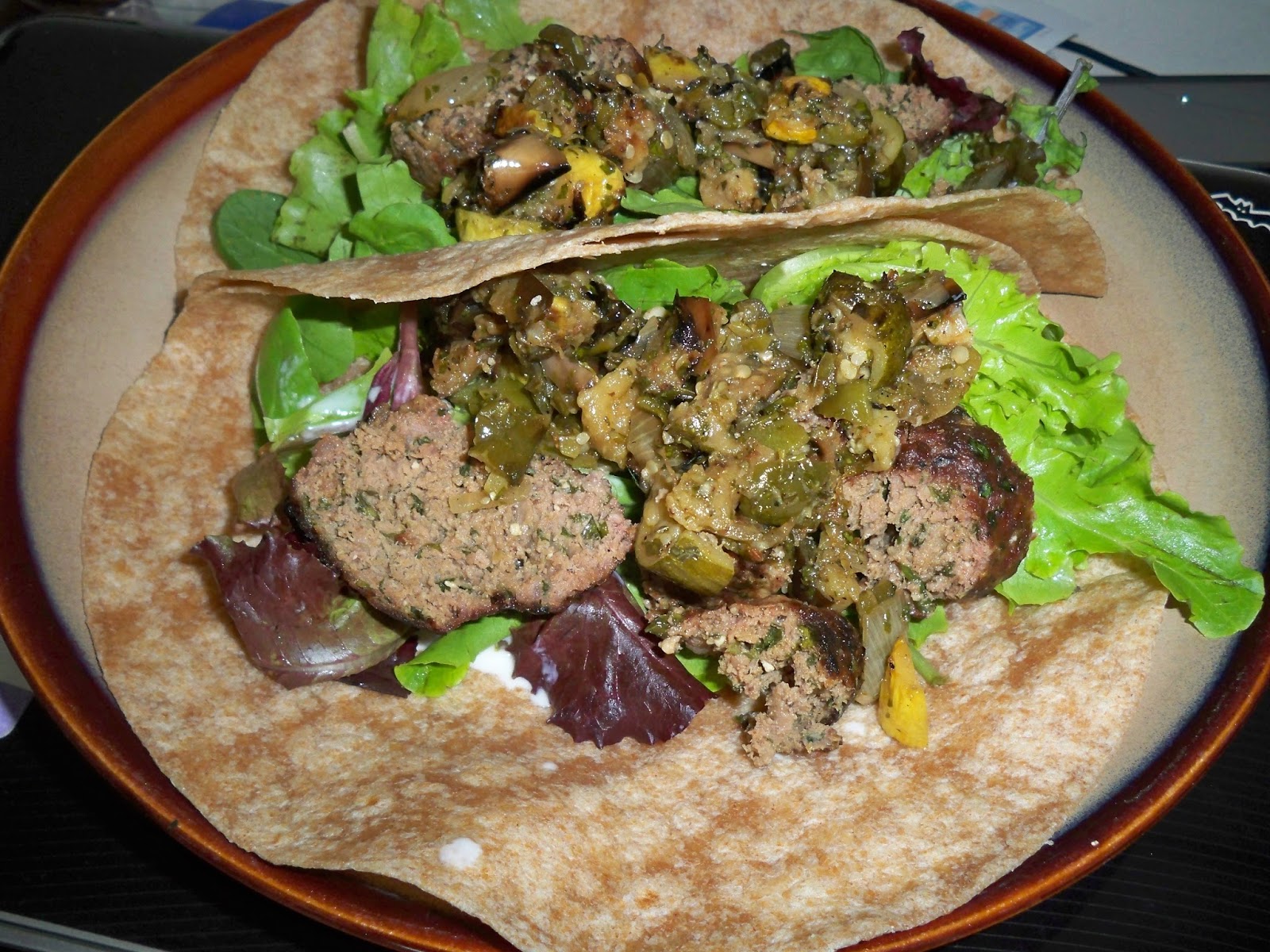
Flavorful, grilled meatballs and vegetables in wraps make a delicious summer pairing.

Two magazines we subscribe to and read faithfully are The New Yorker and Cooks' Illustrated. CI's claim to fame is engineering the perfect version of a classic recipe, with widely available ingredients and often a pared down prep time, as well. I love Middle Eastern foods, spice blends, and lots of fresh herbs in my cooking. The flavors of the recipe for Tunisian grilled vegetables in this summer's issue of CI came to my mailbox at least a month early to try out on this season's fresh tomatoes, so I tried them in a roasting pan of what I had on hand, and confirmed they work well on earlier summer roasting vegetables, like zucchini and summer squash, and in the oven as well as on the grill.

Early summer roasting vegetables: summer squash, zucchini, beets, turnips, radishes, and carrots
Herbs and spices to be tossed into the roasted vegetables. The mise en place bowls contain a cube of frozen garlic scape pesto, and a dry spice blend. At bottom is a mince of parsley, cilantro, and mint.
For a guest who prefers beef to lamb, we made the beef variation offered in the CI recipe for kofte in the same issue. Split and served over fresh greens and with Tunisian spiced and grilled vegetables, on a wrap or over rice. If you serve this with rice, try seasoning the rice right after it finishes cooking, by fluffing it with a fork and tossing in a big handful of minced parsley and mint, plus a little lemon zest. The herbs give the rice a fresh, light flavor that brightens any meal, without overpowering. 


Tunisian vegetable recipe, adapted to earlier summer produce and the oven
Cooks' Illustrated recipes for Grilled Lamb Kofte recipe (requires subscription) with video, and the beef kofte recipe and their Tunisian-style grilled vegetable salad, or mechouia, (also has a video).

Tuesday, July 30, 2013

Cover those veggies: peanut sauce

What a plateful of naked vegetables and rice needs is a thick, sweet sauce to pull them all together.

Welcome this African inspired peanut sauce, based on a recipe from the Moosewood classic, "Sundays at Moosewood Restaurant." The Moosewood Restaurant in Ithaca, NY was part of a movement that tutored a generation of hippies and vegetarians in a new American cuisine, in which we seek out inspiration from everywhere in the world for methods and spices, while still eating what grows locally.


This peanut sauce is not made from such local stuff. But I start with local onions, and substitute local tomatoes (put up last year) for the juice in the original recipe. Plus, it's a delicious way to eat local vegetables.

Another kitchen tip: Buy bananas ahead, ripen in a bag, then freeze them in Ziplocs for smoothies, or to add to this dish.


Peanut Sauce

4 cups chopped onion
1/8 cup peanut oil
1/2 tsp cayenne
1 T freshly ground ginger root
2 mashed, ripe bananas
2 cups chopped tomatoes
1 cup apricot juice
1 cup peanut butter
1/4 tsp sea salt, or to taste

Saute chopped onions until clear, then add cayenne, ginger, and banana. Stir for 5 more minutes, then add juices and stir in. Simmer ten minutes, then add peanut butter and salt.

Serve over rice and steamed vegetables. Also excellent with chicken.


Tuesday, July 23, 2013

Dark and Stormier Cocktail


This spicy ginger drink makes hot summer nights easier to bear.

I like my ginger beer wicked hot. Sometimes I get Sally Fallon's recipe for brewing my own ginger beer to work, and sometimes I don't. When it fails to culture, I now have a product I can buy that's local and as good as I can make at home.

At the Taste of Massachusetts Wine Festival last month, a long line snaked all around the Tri County Fairgrounds. I noticed ginger beer in the program, and made a beeline for it. Green River Ambrosia bottles a Ginger Libation with serious punch. It's so good, Dave bought a case of it, right there. Kevin and I have been buying it, a couple bottles at a time, from Liquors 44 or River Valley Market, both here in Northampton. Drink it chilled over ice, for a kick equivalent to beer, fizz like a soda pop, and a powerful ginger flavor. If I can't use the whole bottle at once, I save the bottle from going flat for a day or two by tightly securing the top of the bottle with a sandwich bag and a rubber band.

Ginger Libation is one of the ingredients in a Dark and Stormier. A regular Dark N' Stormy uses non-alcoholic ginger beer and a shot of Gosling's Black Seal rum. Several versions of the Dark N' Stormier exist, including this one here that has a recipe for brewing ginger beer using Champagne yeast. Here's our own more emphatic version.

Dark and Stormier

Ingredients

1 oz Domaine de Canton ginger liqueur
1 oz Kraken spiced rum
Juice of 1/2 lemon or lime
4 oz Ginger Libation
Ice

Directions

Fill a highball glass (or any 8 oz glass) with ice. Juice the lemon half over the ice. Add a shot each of ginger liqueur and spiced rum. Top with Ginger Libation and stir. Serve with a brightly colored straw.


Check out this post on Hard core soft drinks for a recipe to brew your own alcoholic root beer.

Wednesday, July 10, 2013

You can't "beet" free greens

The "Eat More Kale" campaign might finally be working. But there are other leafy green vegetables out there, if you're open to some introductions.

Kale is cool these days. Everybody's eating kale salad, kale crisps, and drinking kale smoothies. I like a little kale in my salad, but mostly, I like it steamed or braised. I eat some kind of greens nearly every day, more in the summer when they're abundant. Our farm share has been running for a month, and always starts up with plenty of tender young greens. The first shares include turnips, beets, and kohlrabi, all with their greens attached. I've been cooking them all up together in a quick saute with garlic scapes and onions.

These greens feel like "extra" because in past years, I wouldn't have kept the greens. This year, I've been separating the greens from their bulbs or roots, sorting the edible leaves, and composting the rest, to make it easier to fit everything in. Often I'll decide what order to cook vegetables by how unwieldy they are to store. A whole Napa cabbage reduced to two recipes of mustard cabbage with cumin and tomato? Yes, please. I put half in the freezer and we ate the other half last week.

Strawberries were here and now they're gone, ditto sugar snap peas. We captured a few quarts of each and froze them, but we're already moving into green bean season. The year runs so fast, especially in the summer. Before I know it, it will be tomato season.

This past winter was a difficult one for the two of us. A chronic back problem flared up, and I have spent almost a year in bed, on heavy pain medication. Physical therapy, chiropractic, and orthopedic specialists haven't yet put me back together again. I can't ride my bike five miles to pick berries, this summer.

Euro-sealed sugar snap peas
After a winter of having to be taken care of, I want to be back on my feet, but I still rely on Kevin more than I did last summer, and one of those ways is that he now gets the farm share on Mondays after work, instead of me biking out there myself some time during the day to do it. I still process most of what he brings home. I can stand more comfortably than I can stoop or sit, so I wash and stem and label and freeze. We have a new Euro-sealer this year, too. Kevin put up some root vegetables from the winter share, to get us through the spring. We still have a few frozen items hanging around from past seasons, and are putting up some more every week.

Food is one of my love languages, and an easy tongue for some that can bridge awkwardness on both sides. Lee used to come over with fruit I'd never tasted before: durian is one of his favorites. A friend who's new in town, but grew up in upstate New York, often brings me food gifts when she comes over. One time she brought a beet salad, and the last time I'd eaten a beet salad was when I made one for my former girlfriend, Carolyn, when I was first courting her. I have been telling myself for years that I don't like beets, remembering one I tasted as a kid (off June's salad, in a fancy restaurant in Maine.) Now I ask Kevin to bring home beets in the farm share so I can roast them, and eat their greens. Roasted, they have a wonderful texture. Sometimes they're still a bit more earthy than I'm accustomed to, but I want to invite in more flavors again. I find myself craving Carolyn's beet enchiladas, a dish I would never have considered making without having tasted hers.
Fresh lamb's quarters

This time back from visiting New York, Nellie brought a pint of enormous blueberries from her mother's yard. Kevin took half of them and made blueberry pancakes that reminded me of a childhood summer, picking wild blueberries and eating them in pancakes cooked over a fire.

She also brought back two kinds of weeds she likes and has talked up to me, for me to try. One is purslane (feature image), and tastes very mild, like iceberg lettuce, so I've washed it and added it to my salad mix. The other is lamb's quarters, which have matured enough that Nellie suggested cooking it instead of eating it raw. The leaves are delicate, like spinach. I've sauteed them gently with a little bit of scallion and garlic scape from the farm.

The up side of not being able to get the farm share, is that now Kevin gets to enjoy the pleasure of the share room and u-pick fields. He reports that he sings and dances in the share room, he's so happy about the vegetables. I know the feeling: the produce glows from the weathered wooden bins, like the treasures in a video game. This is what we were born to find, and it's deeply satisfying to do what we're made to do.
Lamb's quarters sauteed with scallions and scapes

Able to choose based on their natural vegetal allure, Kevin brings home a few things he would not have requested, when I was making the farm run. He has been beguiled by the Swiss chard. He shows it to me explaining that it just looked so beautiful, he couldn't not take some.

Monday, February 18, 2013

The sincerest form of flattery: the "8 spice," reverse-engineered

The eight spices in the most whole, dry form I had on hand. One of a handful of photographic clues I left for myself  for reverse-engineering a popular cook's published recipe for an 8-spice mixture.
Home cooks have cooked from cookbooks for centuries. Modern cooks also cook from recipes found on the internet. I've been delighted and let down by recipes from both sources. There's a cookbook I still own with a recipe in it so bad that I consider the book to contain a kind of evil by its inclusion.

But I don't generally just hang on to cookbooks to prevent their evil from spreading further into the world. A problem I have with my hard media is that I am a generous, yet forgetful, evangelist. I loan out my favorites and then when I try to loan one out again, find it has already been loaned out, I do not recall to whom. And since it's been so long, I assume, since I've forgotten, I probably won't get it back and, until I buy another copy, will have to live without whatever recipe is in it that I was such a fan of that I loaned out the source.

Such was the case of a cookbook by Ming Tsai that Kevin got through one of those cookbook-a-month deals (in hardcover, even). I can't find it, and so it's either misfiled in the stacks, or I've loaned it out to somebody. Until it resurfaces, I will have to go on recreating from memory the two recipes I really liked out of it, one of which is this one.

I remember enough clues of Ming Tsai's 8-spice that I have confidently reverse engineered it at least twice since losing his cookbook, each time forgetting in my hubris to write down the secret eight. One clue was that five of the spices are in traditional Chinese five spice. I knew that I included salt and pepper, but that they were not counted toward the eight. And I remembered that two are cumin and coriander, a complementary pair of the earthy and the flowery that I associate with Indian curries. But what was the eighth spice?

I turned to the photographic clues I've left myself. Knowing that I'd want to blog about this recipe someday, and that I would likely forget to write down the eight spices, I took pictures. I took the picture above in March, 2011, and the one below, that I took in August, 2011, is very probably based on the one taken in March. I have been using one or the other of them as a "recipe" ever since.

You see that I like a challenge, because while I can see the seeds, I can't see the labels on any but the fennel.
I can never remember what the five in Chinese five spice are, but it's the kind of fact I can Google. They are, according to Wikipedia, today, anyway: star anise, cloves, Chinese cinnamon (meaning, not Chinese cassia, which most Americans accept as "culinary cinnamon," and which I probably have got here as well), Sichuan pepper, and fennel seeds. I can see from the pictures that I didn't use star anise either time I took photos, but substituted regular, tiny anise seed. However, I can remember making this with star anise, the first time I made it. On the other hand, I'm sure I've never had Sichuan pepper in the house, so I must have substituted black peppercorn for this spice every time. Perhaps Tsai made this substitution in his original, or else I have always made it.

Studying both photos, I see the same eight spices: cinnamon, fennel, cloves, anise (four out of the Chinese five spice), plus cumin, cardamom, coriander, and ginger. Salt and pepper (the fifth Chinese spice) are extra, resulting in a nine ingredient spice mixture, plus salt, in my recipe for 8-spice. Good thing I had photos, because that book is long gone, and Tsai's eight spice recipe is not on the internet.

Which left proportions to figure out. When I first made this, I sniffed and eyeballed and weighed spices in my hand, and combined this with my experience of spice ratios in recipes. Starting with a teaspoon, ground, as my basic unit, I cut back on cloves and cardamom, and amped up the cumin to give it more depth. I like a lot of ginger, so when I made braised lamb shanks using this spice blend yesterday, I cooked them in a mixture of softened onion, garlic, and fresh ginger with wine and lamb stock. I was trying to approximate a recipe in which I might have used tomato instead of wine, but again, it was a case of cooking without a recipe and then not so much documenting the results as being proud of them.

Another picture from the November photo shoot, reminding me that 8-spiced braised lamb shanks are delicious.
A note on salt in spice rubs: I don't usually blend the salt into my spice blends when I'm saving them for future use, but when I'm making them up to season a dish I'm going to cook, I mix in salt. To do this, I figure out how much spice blend I'll use on my dish, separate that out into a bowl, and then mix salt into it sufficient for the quantity of food I'm seasoning. Then, I use all of that salted spice blend to ensure the dish gets salted enough. This is especially helpful when I'm seasoning something I want well salted from the start, like meat or pulses.

I had had good results winging it with these approximations. There's a forgiving tradition of mixing together good quality spices to achieve deep flavor, and using that blend on various dishes as a signature flavor, like Emeril's "essence," various curries, and ras el hanout. My favorite use for this 8-spice blend is as a rub on lamb before braising. It is sweetly aromatic and a good counterpoint to strong meat.

Justin's Amnesiac Eight Spice Blend

Half a cinnamon stick, or 1 tsp ground cinnamon
1 T fennel seed
7-8 whole cloves, or 1/4 tsp ground cloves
One whole star anise, or 2 tsp whole anise seed, or 1 tsp ground anise
2 T cumin seed, or 2 tsp ground cumin
1 cardamom pod, or 1/4 tsp ground cardamom
1 T coriander seed, or 1 tsp ground coriander
1 tsp dried ground ginger
2 tsp black peppercorns, or 1/2 tsp ground black pepper

Grind any whole spices you are using in a mortar or a small electric coffee grinder. Then, mix all ground dry spices together. You can store this mixture for future use.

To use the spice blend as a dry rub on meat, mix it with salt (see note above about salt) and rub it liberally on  raw meat. Allow to rest before cooking. The spice blend is also good mixed into sauces, cooked with onions and garlic into pulse dishes, and sprinkled over sweet and starchy cooked vegetables.

Friday, December 21, 2012

Soup for breakfast


Do you make your own soup? If not you, who makes your soup?

The summer farm share season is over. I’ve filled one of our freezers with baggies of blanched kale, green beans, sugar snap peas, skinned and seeded tomatoes, and tomato sauce. Kevin roasted pans of eggplant slices and froze them. Two of the four animals we’ve arranged to receive all or part of this winter have arrived and are in there, too.

I’ve had decreasing interest in cooking. It’s hard to explain. My interests have shifted. At the same time, Kevin is showing an increased interest in the cooking, and has been doing more of it. He’s fussier than I am and I am willing to let him take over. But now I’ve bumped against the bottom. This morning, I burned the soup he prepared this morning, warming it up to eat. I should have set a timer, because when I’m working it’s hard to get my attention from meat space, and forgot about it long enough for it to anneal itself to the bottom of the pot. When I’m so distracted from food and cooking that all I can get it up to do is warm (burn) soup and grill a sandwich once a day, that’s as far as I get. To let all of the shopping, farm share pickups, and cooking go, not even to wash the dishes afterward, is too far. It means I’m depressed. I’m just lucky that I have people who love me who will cook for me when this is the case.


If your soup comes out of a can, it’s pretty much guaranteed to be full of poisonous crap that you would never knowingly put into soup that you are feeding someone to make them well. It’s probably made from conventional produce, including the Dirty Dozen, so it’s full of pesticides. It’s got more salt, MSG, and “natural flavors” than anything you’d cook yourself.

Soup cans leach dangerously high levels of the endocrine disruptor bisphenol A, or BPA into the food. This synthetic, estrogen-like substance has been linked to a host of health problems, and a JAMA published study found that eating a can of soup a day for a week increased blood levels of BPA by more than 1,000 percent.

If it contains animal products, it’s very likely made from animals fed genetically modified grain, antibiotics and growth hormones. Yet the soup base is clearly not a bone stock, or when you opened a can of soup, it would be very thick and gelatinous, not a thin, pourable liquid, as is generally the case. Bone stock is full of minerals and protein from collagen, both good for you and absent from canned soup. Sarah, The Healthy Home Economist, makes videos showing you how to make different kinds of stocks, and what a properly gelled stock looks like. Here’s my own all-purpose stock post that includes variations for any kind of bone or fish stock, and vegan roasted vegetable stock.

Lately, Kevin makes me soup for breakfast. He started eating it about a year ago, when he made some changes to his diet. At first, I wasn’t interested in eating soup first thing in the morning, but it’s slowly grown on me. At first it was just weekends. Near the end, I was asking him to make smoothies, gluten-free pancakes, and chicken soup for breakfast on weekends: the “full breakfast.” Now we make our own smoothies (they taste best when perfectly fresh) and Kevin makes soup each morning and leaves half for me. The smoothie is frozen fruit---strawberries, blueberries, bananas---yogurt, and whole milk, blended. Soup is a fresh preparation of meat and vegetables with miso and kimchi. Sometimes he previously baked chicken thighs, or the occasional bit of pork, but recently it’s beef: something from the round, or some loin flap meat. Sometimes he’ll add minced pork fat, if the meat is lean. The vegetables usually include bell pepper and zucchini, in the summer, but he’s getting more flexible. Last winter I was buying bell peppers grown halfway around the world, and not feeling great about that, but ambivalent, because Kevin was so happily cooking his own food after years of letting me do all of the food preparation. He’ll still buy a pepper most weeks, and sometimes a quart of mushrooms, but most of the vegetables are from our winter share: turnips, carrots, parsnips, radishes (watermelon and daikon), rutabagas, sweet potatoes, delicata and butternut squashes.


Now, he’s taken on just about all the weekend cooking as well as our breakfasts, and because we share the responsibilities for making fresh food, I find our values are more in alignment around how we spend our time and money on what we eat. He’s oriented toward being economical and thrifty in following the seasons and our farm share, like I am, and takes pride in using what’s in the fridge to best effect. While I’m the king of the big batch, he is good at making something from a little of this and a little of that. Soup is right in the middle of that wheelhouse.


Some people call this “garbage soup” when they make soup from leftovers. We call it putting a cap on the cost of food, and valuing what we have. We say to each other, fairly often, that we are very lucky: we get to eat some of the best food we can even imagine. We eat far better than either of us did in childhood, maybe better than anyone we know. It’s definitely exactly what we choose.

Kevin didn’t used to like soup much. I don’t know what has caused the change: some coming together of several different ways in which he could suddenly perceive what he wanted, and feel confident in pursuing it. I know part of my adoption of breakfast soup has been phasing out coffee, and other things that upset my stomach. Soup, finished with another generous helping of kimchi, is flavorful, comforting, not acidic at all, and not too filling or daunting to digest.

And my husband makes it for me, so it’s full of love.