Friday, May 25, 2012

Recipe: Roman hash


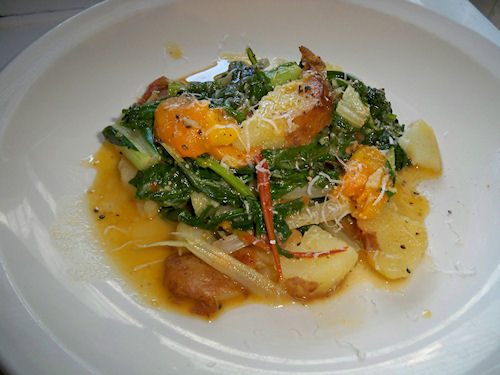
The types of greens or potatoes you use in Roman Hash are up to you; you can even choose to fry the potatoes in bacon fat, or skip the cheese at the end. If you use both very hearty greens (such as collards) and very delicate greens (such as arugula), chop them into separate bowls, and add the heartier greens to the pan first.


Serves 4 as a light meal or a substantial side dish.

Ingredients
⅓ cup olive oil
4 medium potatoes, boiled
3 medium tomatoes, or comparable quantity of canned whole tomatoes, diced (not canned diced tomatoes): about a pound
6+ cloves of garlic, pressed or finely minced
7+ cups of washed, loosely packed, chopped cooking greens (e.g. collards, kale, mustard greens, dandelion greens, arugula, chard)
½ tsp salt, or to taste
¼ tsp freshly ground pepper, to taste
Pecorino Romano or your favorite hard grating cheese, to taste (optional)

Equipment Needed
Large (14-inch or larger) nonstick skillet (an iron skillet is preferable)
Large pot with a lid
Colander
Cutting board and knife
Garlic press (preferable but not required)
Fine grater for cheese (if using)

Slice the boiled potatoes into half-inch thick rounds. Put the skillet on a medium-high flame and add the olive oil. When the oil is hot, add the potato slices in a single layer. Allow the potatoes to cook, undisturbed, for several minutes until they are lightly browned. Salt and pepper, and turn and redistribute the potatoes as needed to brown and heat the slices.

Add the tomatoes and garlic and stir, allowing the potato slices to break up. Cook for a few minutes, salt and pepper some more, then add the greens, stirring in a large handful at a time and allowing them to wilt slightly to make room for more. Continue to cook and stir until the greens are completely wilted and the dish is not too soupy. Taste for salt and pepper. Serve with a grating of hard cheese, if desired.

Monday, April 30, 2012

Quick braised hearty greens

How to shop for, prepare, and love kale and collards.

Our winter vegetable share has ended, and our summer share has not yet begun to produce. The winter farmer's market, where I was getting some early salad and braising greens, is over and the summer market will not start until next month. I find myself more often at the supermarket and the co-op, choosing from among the imports. Even my potatoes and cabbage are being shipped from California.

Butter paneer masala over rice with a side of kale
There are spring foods, and I'm glad to add them back into my diet: raw milk returns, including the locally made cheese that I make into butter paneer masala.

When the asparagus comes in, I make it every other meal. But mainly, spring is still about living on reserves of starchy vegetables, meat, and grain put by the year before. I think a green vegetable is necessary, too. In winter, we eat more cabbage in the rotation, and in summer, there's more green salad and a lot less cooked greens. In spring, when I run out or asparagus for a minute, it's back to the leafy greens.

I like kale and collards because I can prepare them simply, and use them interchangeably in other dishes or as a simple side. They're the foundation of a breakfast of lightly fried eggs over greens, and go into stew or beside a chop for lunch or dinner. While it's traditional to boil the hell out of them, they don't need to be cooked long to be thoroughly cooked, and they're also good just barely steamed. You can even eat them raw as salad, if you shred them or they're young and tender enough. Some foods we eat year round, and leafy greens are among them.

The dark leafy greens, along with other coles and green vegetables, are deserving of their own food group. The coles include cabbage, kale, and collards, as well as broccoli and Brussels sprouts, and other, non-cole  leafy greens include mustard, calaloo, and dandelion, though these are by no means exhaustive lists.

Oven-baked suet fries and buttered,
grilled asparagus pair with
mustard-brown sugar glazed salmon.
I fall back on a few ways that I will prepare dark green leafy vegetables. This is a practice for braising simple and flavorful greens that go with anything and everything.

How to prepare dark leafy greens:
  1. When you're purchasing collards, especially, make sure the leaves are crisp and fresh, not wilted and sagging. Avoid collards that have many tears or marks on them from insects.
  2. To wash them, fill your sink halfway with cold water and gently swish and rub the leaves in the water. Rub both sides of collards leaves lightly under the water to remove residue: even organically grown greens have soap and dirt on them. (If this seems like too much trouble, consider that organic, ready-to-eat, pre-washed greens are washed with a chlorine bleach solution, and are sometimes recalled for spreading infection instead of destroying them.) Shake them dry.
  3. Inspect the leaves for bad parts to remove: any place that is wilted, brown or black, or otherwise shows evidence of insects having eaten it. Look for the eggs of insects that are sometimes found on the underside (the matte, light green side) of the leaves, and tear out these parts of the leaf.
  4. Cut or tear the thick parts of the stems from the leaves of collards and kale.
  5. Tip: If you're feeling really thrifty, you can chop all but the woodiest stems and start them in a braising liquid, then add the chopped leaves near the end.
  6. Gather the leaves into a roll or pile and slice them. A very thin slice looks elegant and is a nice texture under something delicate like a fried egg. A big, thick slice goes well with something like sausage or potatoes.
  7. Start some fat over medium-high heat in an iron skillet: at least a tablespoon or so or olive oil, butter, or bacon grease. Add a little thinly sliced onion, some red pepper flake. When the onion is lightly browned, add minced garlic or ginger if you like.
  8. Add the greens in large handfuls that nearly fill the pan. Move the greens around, cover if necessary to get the greens to wilt down. Salt what's in the pan, then add more greens. When all of the greens are in, add a liquid: just water is okay, but wine can be nice, and stock is my favorite. You only need enough to steam the greens: about a quarter of a cup will do. Cover and turn the heat down very low. They'll be ready to eat in ten minutes or less.
If you're in a hurry, skip the aromatics and just wilt the greens in some hot fat.

If you're really in a hurry, just steam the greens in stock.

Tuesday, April 10, 2012

Rendering beef fat for perfect French fried potatoes

How to transform a lump of animal fat and some dirty tubers into that crisp divinity, the perfect French fry.

Rendering beef fat is a smelly business. It looks and feels like stinky candles. It takes hours to render any quantity of raw cubed fat, and the odor is unpleasant and weird. But it’s worth it. Once you’ve rendered a bunch of suet, you’ve got a very hard, creamy cooking fat that’s good for all kinds of uses.

When you cook down balsamic vinegar into a syrup, the harsh part aromatizes. It’s in the air. I went to my girlfriend’s house when she was making a reduction, last week, and the wave of vinegar hit me in right the nose as I walked in. But then I ate the balsamic reduction---a little scoop of the gooey stuff on a pear slice had me agog with wonder---and realized that the harsh part was gone. Same with rendering fat. Like the last time I made a big batch of fish stock, I get some criticism for stinking up the joint making these preparations, but zero complaints about the food that results. 

Rendering removes the impurities. The nasty smells cook off, and there will be some chunky stuff left over that you’ll throw away. What you keep is smooth, hard, and a whole lot better for you than shortening or vegetable oil. It’s prized for making flaky pie crusts, crispy batter-fried fish, and the kind of French fries that built a fast food empire

I wrote this week on my other food blog, Tin Foil Toque, about how McDonald’s used to use a mostly-beef fat solution for their famous fries. They still use some kind of animal product to flavor their potatoes, even after switching to vegetable oil for frying, because that is what their fries are supposed to smell and taste like. If you’ve fried fresh potatoes in oil at home, perhaps you were disappointed that the result was not as mouth-watering as what you could get at the drive-through. However, if you make your own fries at home using tallow, you can get the ur-experience that McDonald’s used to deliver, and which has become nearly unknown in its original form: French fried potatoes fried in beef fat. You can still get the modern, industrial version: genetically modified Russet Burbanks coated with “natural flavors” and fried in the oil of genetically modified grass seeds.

Or, if you prefer your food to nourish you instead of kill you, if you are sufficiently motivated, and you have access to high quality fat from pastured cattle, you can make the most perfect fries ever: crisp, not greasy, with lots of umami, and best of all, good for you. 

How to render beef fat:

Start with the best quality fat you can get. Trimmings from roasts and steaks can be saved in the freezer until you have enough to work with, though I usually get it in large lumps of 1-2 lbs, frozen, from the slaughterhouse with my beef order from local farmers. Pastured cattle makes the healthiest fat.

Raw beef fat is thick and waxy.
Use a very sharp knife for handling fat, as it’s slippery and contains tougher tissues within it that offer more resistance.
  1. Trim any visible meat or other tissue and throw it away or save it for stock. Cube the fat into roughly one-inch cubes or, for faster results, mince the fat. 
  2. Roast the fat in a casserole dish, roasting pan, or Dutch oven at 250° F. Open or closed both work, but a closed dish stinks a lot less. 
  3. Stir or shake the pan a few times during the day. If you don’t chop the fat finely, this can take several hours. Even if you do, it can take a couple of hours. 
  4. When you’re no longer making any progress (the stuff that won’t dissolve isn’t getting any smaller), call it quits. 
  5. Strain the fat through cheesecloth into a glass jar. Throw away the solid parts. The rendered fat will keep in your fridge for at least a month. You can also firm it up in any sort of mold, like in ice cube trays or muffin pans, then freeze the molded chunks so you can grab a bit of tallow any time you need a bit of tasty cooking fat. 

Pigging out on ribs and fries

The first thing I did with my freshly rendered tallow was to deep-fry French fries. I admit that I wasn’t entirely sure that tallow would give good results, because I hadn’t cooked with it before. Would my potatoes taste like my house smelled on rendering day? Would they be soggy?

Friends, they were perfect. The reason the potatoes get so crisp is because the fat has so little moisture. Compare the texture of refrigerated beef tallow to butter, and you start to understand what makes that delicious, suet-flavored crispness in fries, but also in other foods I’ve eaten: empanadas are best made with suet, now that I recognize the effect.

I made ribs with the fries, and some cole slaw, and we ate such a pig-out meal, I felt like I was completing a religious rite, it was all so carefully sourced and prepared. This is what I mean when I say that I make comfort food. French fries and pork ribs are supremely familiar, comfortable, and delicious, and yet also a little special. My mother didn’t make these foods; we got them from Chinese take-out and from the fast food drive-through, and later, when I was older, from cheap barbecue joint holes in the wall I found with my friends, and expensive hipster dives in cities, where they fried the potatoes in duck fat.

This is food that I’ve enjoyed most of my life, and for most of that time, it was both mysterious and dirty: bad for me, irreproducible. Now I know how to make pork ribs (I’ll share that recipe with you another time), and how to make fries. I know how to transform a lump of fat and some dirty tubers into the food that has become more American than apple pie. Not only do I know how to make the food, but I know how to make it so that it doesn’t make me feel sick or guilty, or wonder what was in it. I know what distinguishes the pig in my freezer from the one at the closest supermarket, my fries from McD’s. I know which parts are miracle, and which are cheap tricks.

Now, it is medicine food.

Real, good food is better than magic.

How to make French fries:

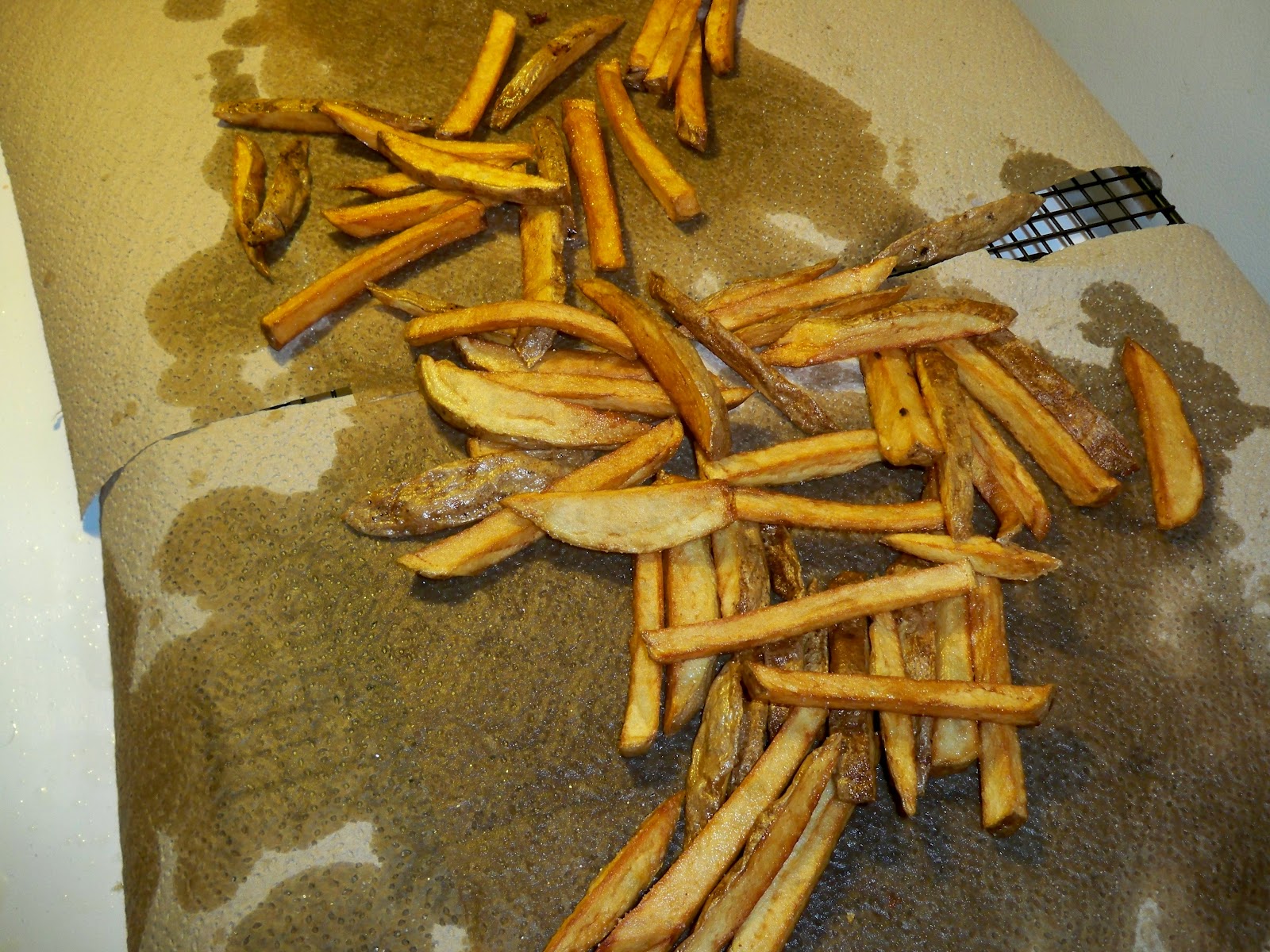
The secret to crispy fries is twice-frying. Slice your potatoes as thin or thick as you like them. I favor a steak-cut thickness, and keep the skins on. Get your heavy pot of fat nice and hot, and fry a small quantity of potatoes at a time to keep the temperature steady. Fry them once for five minutes, then scoop them out and let them drain on paper towels. Let them sit until you’re almost ready to eat. Then fry the potatoes again in batches, one minute per batch, and drain again on paper towels. Salt them right after they come out of the fat the second time. Serve immediately.

After frying, strain the fat while it’s still fairly warm. Let it cool and put it back in the fridge. Unless you’re frying fish or something else really smelly, you can generally strain and re-use the fat for frying. I use masking tape and a Sharpie to label anything I put in the refrigerator, and in the case of rendered beef fat, I will also note what I’ve fried in it.

Oven fries

Frying takes a lot of fat. And frankly, my husband and I both prefer the taste and texture of roasted root vegetables. Fries can be a fun treat, and sometimes they’re just what I’m craving. But for the most part, I’m much more likely to roast up a pan of sliced potatoes with a hearty dollop of beef fat (which I take right out of the fry-fat jar). It takes longer to bake---about an hour on 350°, turning them every ten minutes---but is less trouble, doesn’t tie up a quart of fat, and tastes just as suet-y and crispy as the deep-fried kind.

Saturday, March 17, 2012

What's for dinner

I will sometimes take a picture of my dinner, especially if I'm thinking of this blog and want to document what we're eating. I like the idea of doing this often enough to get a seasonal portrait of our food. I can come back around next year in late winter, before the fresh spring food appears, and see what I came up with to eat. Last year around this time, I discovered crunchy, spicy salads. In the past year, we've learned to eat gluten-free, and have been eating even more whole animals.

Turkey legs from Thanksgiving, out of the freezer and stewed with tomatoes, cumin, and jalapeño, served with roasted root vegetables
Roasted vegetables are one of those dishes I like to make a lot of, and from whatever's in season. Through the winter, I like to make pans of roasted root vegetables and big pots of steamed kale, then eat them til they're almost gone and then do it again. I learned long ago there's no shame in warming up something left over, and even less if you make something else fresh to serve alongside.
Chicken curry sausage from the co-op, roasted root vegetables, and steamed kale

Pan-fried pork loin chop, roasted root vegetables, and steamed kale
This pork chop came from the half pig in our freezer. Usually I rub it with salt, pepper, and coriander, then pan fry it to medium doneness.
Locally grown and frozen green beans from the co-op (sweeter than any other kind you can get this time of year), salt-roasted sweet and white potatoes, and roast leg of lamb
Salt-roasted potatoes are a delicious alternative to roasting them with oil. After washing your potatoes, throw them into a casserole dish or roasting pan, salt them generously, and roast them in a medium-hot oven, 350-400 degrees F, for about an hour for small potatoes, shaking them every 20 minutes or so until they're done. The insides get fluffy, and the skins get chewy.
Fresh ham steak marinated with marjoram, broccoli roasted with garlic, and summer roasted vegetables from the freezer
Broccoli is also surprisingly tasty, roasted. Kevin doesn't usually like broccoli, but we're both crazy about roasted Brussels sprouts. Roasted broccoli comes close in flavor and bite.

I do most of the cooking, but Kevin's gotten into the kitchen more often, especially on weekends and to do a bit of gluten-free baking. A friend turned us on to Pamela's baking mix, and it's everything I could ask for in a gluten-free mix. The blend of rice and almond flours is perfect for biscuits, pancakes, and cornbread, and her baking mix has leavening in it, so it's ready for use in any kind of quick bread. These drop biscuits with currants Kevin made for St. Patrick's Day in lieu of Irish soda bread were buttery and flaky. I haven't been eating gluten-free---most days, I still eat a grilled egg and cheese sandwich---but I don't miss wheat flour at all when I eat these biscuits.
St. Patrick's Day dinner of beef bangers, gluten-free Irish soda bread biscuits, and cabbage braised with onion and apple
Chicken roasted with aloo gobi and its spices, and plain steamed kale
When I made my usual aloo gobi recipe recently, I made a double batch of the spices, rubbed a chicken under its skin with one batch, and seasoned some cauliflower and potatoes with the other. Instead of making the aloo gobi on the stove top, I oven roasted everything together.
Red snapper fillet baked with butter, mushroom risotto, and roasted broccoli with garlic
I haven't posted my usual risotto recipe, which uses mushrooms and a sharp grating cheese, but there's this one for fiddlehead and asparagus risotto that I am really looking forward to making again. Spring is so close.
Collards omelet and aloo gobi
This isn't dinner, but it was pretty and I was sitting down to eat this for brunch with Kevin on a weekend not long ago, so I took a picture. The aloo gobi is equally good for breakfast as it is for dinner.

Sunday, March 4, 2012

Kale and Pork


Cassoulet over steamed kale
Two fine foods that go great together, especially in winter.


I treat kale and collards as interchangeable, being sturdy, leafy green vegetables with relatively unassertive flavors. They take less time to cook, but longer to wash and chop than cabbage, another brassica I will sometimes substitute for either kale or collards. They can all be steamed, rolled, and stuffed, as in galumpkes (what the locals call cabbage rolls). They’re all good in braises, soups, and stews. I eat greens at breakfast. They’re great under a stew. 


Pork belly, cornbread, collards with garlic, fresh ham steak with marjoram, and roasted root vegetables
And while all year round, I try to eat something either leafy green or some other vegetable that is botanically vegetable and not fruit (think broccoli, not tomato), in the summer that is often salad, and in the winter it is far more often kale or collards. I picked this idea up from reading Laurel’s Kitchen, where she suggests eating a “super vegetable” every day: a pod or leafy green.
Roast pork, roasted mixed root vegetables, and steamed collards
Greens go with everything. These are dishes I ate in the past couple weeks. Can you see how rare that pork is? No, we're not worried about it. Getting to eat pork as rare as we would eat beef is extraordinary. It's more like lamb. We eat it like this sometimes, when I manage not to overcook it. It's one of the culinary advantages of really knowing where your pork comes from.


The other thing about pastured pork, though, is that it is porky. You know that smell you get off of pig's feet? It's like that, only more so. In fact, the more I eat local, pastured meat, the more I am convinced I can taste their feed, and that industrially raised meat tastes more like corn than it does like chicken, beef, or pork. 


Kielbasa, braised cabbage, and homemade baked beans
Switching to pastured meat could mean finding out you don't like meat as much as you thought you did. I like strong meat (my personal blog is called Strong Meat) but I still cast around for some solutions for mitigating the extremely porky smell. Even the sausages we got from the slaughterhouse, as highly spiced as they were, smelled like this. The taste is a little less noticeable, but still there: a barnyard essence that reminds you this was an animal, a particular one that lived in a place and ate what it liked to forage. Eggy eggs are tremendously rich. Chicken-y chickens are the ur-chicken of chicken-ness. Lamb can be more or less sheep-y. Grass-fed beef is distinctly beefy. Pork was our most recent transition, and not only took a little time to get to appreciate, but to learn to cook with. 


Eggs over medium, potato latkes, a pork sausage, and braised cabbage
I learned that pastured pork goes well with vinegar, or smoke. Some traditional preparations have you soak the pork in vinegar before cooking it, while others use it as a flavoring in stew. Other acids, like tomato, also pair well with strong pork. My Sicilian family has always put pig's feet in tomato sauce. Last night, you could find me exclaiming over a pork and tofu stew at our local Korean restaurant. The stew, which included lots of kimchi, suggested another traditional pairing for pork that's popular around here: sauerkraut.


Monday, February 20, 2012

How much do you spend on food?


Do you spend a normal amount on food? What is a normal amount, anyway, and what kind of food do you get for the money? How much is enough?


Graph: Monthly spending on groceries and restaurants: my household,  finance blogger and Portland foodie J.D. Roth, the average Massachusetts household, the average American household, and the average household in nearby West Springfield, MA.

Hey, big spender

Kevin and I spent $22,320 on food in the last year. That’s $930 per person, per month, or about $10.33 per meal. That’s for everything: meat and drink, junk food and fine dining, farm shares and grocery shopping. It includes holiday food and dinner parties. After taxes and rent, it’s our largest expense.

Is it a lot of money to spend on food? I could compare it to what other people spend. But who? And what are they eating for their money?

I know that our values around food mean that I should expect our grocery spending to be higher than average. And boy, is it. We probably spend three times what this guy does on groceries:

What is average?

The reason we spend so much on groceries is that we care a lot about the qualities of our food: where, how, and when it was raised. We Americans spend somewhere around eleven percent of our income on food, say our government agencies, though even they can’t agree on a precise figure. In this graphic on Visual Economics, the average American household spent 12.4% of their income on food, close to the 13% spent on food in these US Census figures. An expert quoted in this MSNBC news piece says that families spend more like 15-20% on food, including both groceries and eating out.

People don’t keep buying more and more food as they make more money: as people rise out of poverty, they buy enough food, and then they buy better quality food. They also buy more restaurant food. Eventually, food spending levels off as a percentage of income. The richest people (those making over $125K) spend ten percent or less of their income on food, while those in the lowest income bracket (earning below $20K) can easily spend a third of their income on food.

Who should Kevin and I compare ourselves to? Starting with an official recommendation, the USDA considers spending about $240 a month, per adult, on food “moderate.” In the Visual Economics graphic linked to above, the average American household spends around $200 a month per person. According to the US Census, for all households making less than $70K, the average spent on food is almost twice that: almost $400 a month per person.

How much is that per meal?


If you are spending $400 a month on food, that’s less than five dollars a meal.
When Slow Food USA challenged Americans to come up with alternatives to fast food, people made fresh food for five dollars a meal. The premise of the $5 Challenge was not only that home cooking is comparable to the price of a fast food meal, but that it was superior in many ways.

It’s possible to eat well on half this amount. This family ate really well for $2.38 a meal, mainly on fresh, local foods prepared at home, to demonstrate that such a diet is not beyond the reach of even moderate budgets. The difference lies in their resourcefulness and dedication to their goal.

Not long ago, there was news of a study claiming Americans can’t afford to get enough potassium. Potassium is one of the easiest, cheapest nutrients to get enough of: it’s in almost all fruits and vegetables. The claim was based on what the people who do eat enough potassium shop for, and how much of those foods you would need to eat to get enough potassium, not the cheapest way to meet your nutritional needs. People who eat well enough generally spend more than $2.38 a meal, which is not to say that the only way to eat well enough is to spend more, only that it gets easier when money is less of a factor because you have more options.

What do we eat, when we eat out?


Most of the reports I’ve found on spending indicate that just about all Americans spend somewhere between one and two times the amount on groceries that they do on restaurant food. Americans eat out twice as often as we did in the 1970s, and as income rises, people spend more money on restaurants.

Although Kevin and I are off the charts when it comes to grocery expenditures, we’re cheap when it comes to eating out. We rarely go out to eat, spending less than $175 a month on restaurants and take-out. While finance blogger and self-described Portland foodie J.D. Roth and his partner spend more than a third of their food dollars out, like the average American family, Kevin and I spend less than ten percent of our total food budget away from home.

Food that people prepare at home is more nutritious than what they buy in restaurants, according to this USDA economic bulletin. Restaurant meals don’t necessarily get healthier, the more money you spend. In fact, while people will seek out a sit-down restaurant in part because they want to eat “real” food, they can make even worse food choices than are available at a fast food drive through. The Heart Attack Grill, home of the Triple Bypass Burger, is a sit-down option, and if you weigh more than 350 lbs, it’s free. Which just goes to show that every meal has its price.

Monday, January 2, 2012

Three quick breads


Quick breads are an easy way to make dinner special. If you’re new to cooking at home, learning one of these dishes will give you a flexible staple you can make your own: add chocolate chips or bacon grease to brownies, your favorite herbs or cheese to farinata, corn or bacon to plain cornbread, and it’s a whole new dish. Since each of the these three quick breads can be made without wheat flour, they’re especially welcome treats for people on gluten-free diets.

What’s a quick bread? Generally speaking, a quick bread is an American term for baked goods made with chemical leaveners instead of yeast. These are breads that are best served hot and fresh, and can be part of any meal, snack, or dessert. Common quick breads include buttermilk biscuits, scones, and cornbread. In addition to savory items, quick breads include sweet cakes, soda bread, banana bread, and the like, as well as brownies.

For this post, I’m using the term more broadly to include any baked goods that don’t use yeast or fermentation, and so can be turned out quickly.

Pro-tip: If you new to quick breads and working with wheat flour, don’t over beat your batter. This causes the gluten to develop, and will make your bread tough.

Quick breads are newbie-friendly. None of these breads require the binding action of gluten. This makes quick bread an ideal category to start with, if you’re learning to bake gluten-free.  

Brownies are a sweet quick bread.
Brownies. Usually made with eggs to leaven, especially the chewier varieties. My go-to gluten free brownie recipe uses coconut flour and a little rice flour. “Let’s Do... Organic” brand coconut flour features a recipe for “Alison’s Wheat Free Brownies” on the back, which I found here online. This post from the “Nourished Kitchen” blog is a general primer on subbing coconut flour in baking.

Cornbread. Although most gluten-free baking primers will suggest something other than a 1:1 ratio, substituting rice flour for the wheat flour in my regular recipe for cornbread, out of Mark Bittman’s How To Cook Everything, turns out a good result. It’s a little paler in color, but has great flavor and texture, and only slightly more crumbly than regular cornbread made with wheat flour. I made it with blue cornmeal once and the resulting bread was sort of pink. A little weird-looking, but it tasted good.


Farinata. While not technically a quick bread, farinata’s texture and utility make this more like cornbread or polenta than the pancakes and crêpes it is compared with. Made with chickpea flour, this traditional Italian dish is a versatile starting point for a whole meal. You can make a thin, herbed farinata to accompany soup or stew, or you can make a thicker one and add vegetables and cheese. This could be a great vegan breakfast: chickpea flour, olive oil, garlic, fresh oregano, and some cooked vegetables, all cooked together in a skillet. Cold farinata is good, and can be creatively topped and broiled. Farinata topped with pepperoni slices and cheese and broiled until the cheese melts is a tasty grain-free pizza.